Have you ever had a patient come in after a stroke, and they have weakness or atrophy of the limb?
They may have poor grip strength when you shake their hand or when they try to open a pickle jar. Or the may have some tingling and numbness down the arm.
Well, there's a needling technique you can try that will activate the entire channel and draw qi and blood into the limb.
It's called the Chain and Lock Method, and it's what we're talking about today...
But first, here's some updates on the gallbladder sludge course...
The Chain and Lock Method
This is something you've probably experienced before: a patient comes in after a stroke complaining of weakness of the limb or loss of sensation.
They may not have full-on hemiplegia, but they may have poor grip strength or numbness and tingling down their arm.
Well, one needling technique you can try is something that Deadman calls the Chain and Lock Point Association Method...
Chain and Lock
This method is a little bit different from selecting local and distal points.
With the Chain and Lock Method, you're selecting a series of points down a single channel (usually at the major joints) in order to treat the entire length of the channel and the region/limb that it traverses.
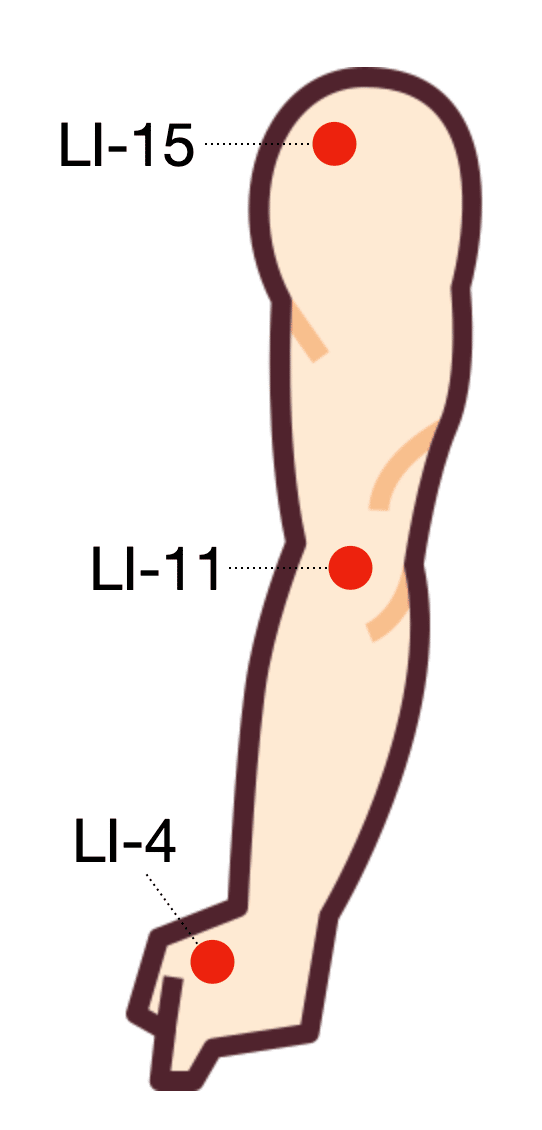
For example, if you want to open up the flow of qi and blood into the arm, you might choose LI-15 (Jianyu) → LI-11 (Quchi) → LI-4 (Hegu).
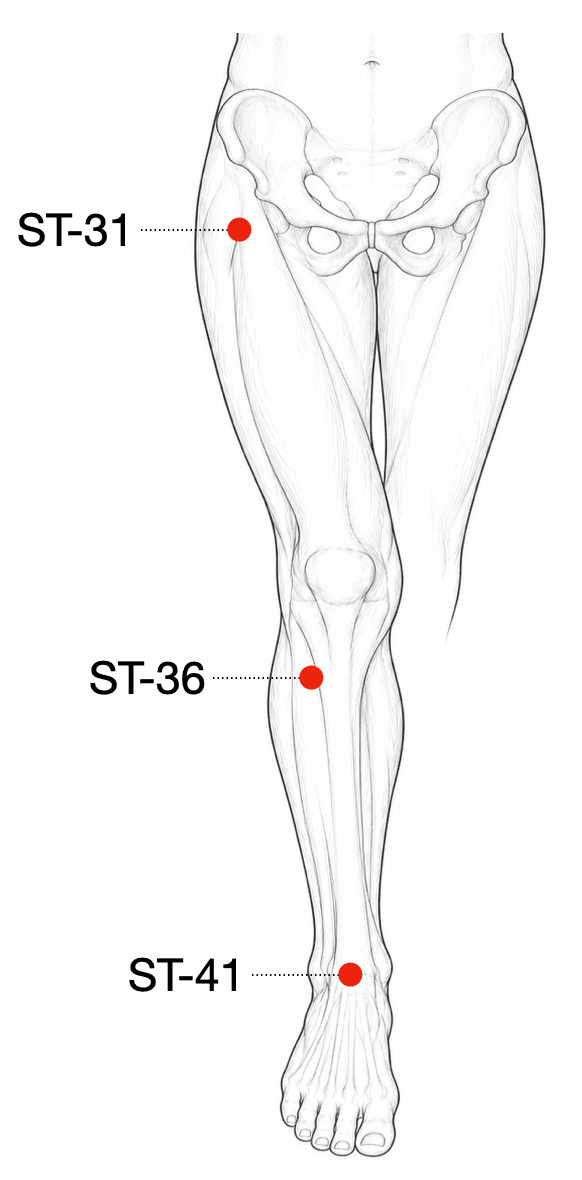
If you want to treat the leg, you might choose ST-31 (Biguan) → ST-36 (Zusanli) → ST-41 (Jiexi).
So instead of combining a local point and a distal point to treat a specific region, you're "chaining" together a series of points to treat the entire channel.
(連 lián means "to link or connect", and 鎖 suǒ means "a lock". But they can be used together to mean "chain" or "interlinked". So you can think of this as the "chain-link" point combination method.)
This method is commonly used to treat hemiplegia and atrophy syndrome. But it also works for other channel conditions — bi syndrome, chronic pain, peripheral neuropathy, sciatica, even frozen shoulder.

The Yangming Channels
As you saw in the examples above, this technique is most commonly used along the Yangming channels to treat hemiplegia and atrophy syndrome (aka wilting or limpness).
One reason for this is that the Yangming channels are "full of qi and blood", so we can use those points to draw qi and blood into the limbs to treat atrophy and loss of sensation.

But why Yangming specifically? The Su Wen actually addresses this directly. In Chapter 44 ("Discourse on Limpness"), Huang Di asks the question:
The discourse states: "To treat limpness, select only the yang brilliance." Why is that?
And Qi Bo replies:
The Yangming channel, it is the sea of the five zang and six fu. It is responsible for keeping the basic sinews moist. The basic sinew is responsible for binding together the bones and for the free movement of the trigger joint.
So in treating any kind of 痿 wěi syndrome (atrophy, wilting, or limpness), the Nei Jing recommends using points on the Yangming channel.
Other Channels
That said, you can still use the Chain and Lock Method on other channels.
For example, for frozen shoulder or pain in the posterior shoulder, you could use SI-10 (Naoshu) → SI-8 (Xiaohai) → SI-3 (Houxi).
(I've also used this with tingling in the pinky finger, usually due to some impingement in the neck/shoulder area.)
For pain in the buttock and posterior leg, you can needle BL-36 (Chengfu) → BL-40 (Weizhong) → BL-60 (Kunlun).
(And even though Deadman doesn't mention it, I've sometimes used a similar strategy for sciatica that runs down the GB channel: GB-30 (Huantiao) → GB-34 (Yanglingquan) → GB-40 (Qiuxu).)
Not Exactly Classical
Even though Deadman's A Manual of Acupuncture lists this as a point selection method and even lists its Chinese name (連鎖配穴法 lián suǒ pèi xué fǎ), this doesn't appear to be a classical technique.
It doesn't show up in any of the classics, and it's not clear who named it, why, or when. It most likely just appeared in 20th-century PRC acupuncture textbooks when methods and teaching frameworks were being systematized.
But wherever it came from, it's a useful addition to your point-selection arsenal.
So in addition to...
- local, adjacent, and distal points
- points above to treat below / points below to treat above
- same-name channel points (e.g. using PC points to treat the LV channel)
- cross needling (i.e. points on the opposite side)
- empirical points
... you can also select a series of points along a single channel to open that channel or treat the area it traverses.
Over to You
How about you? Do you use this method, and which channels/points do you regularly go to?
Let me know.