For the last several weeks, my allergies have been terrible! Itchy eyes, runny nose, hard to get out of bed, and sooo much Kleenex.
And at least for me, using medications like Claritin or Allegra either do nothing, or they cause side effects that are worse than just having allergies.
So here are some TCM ideas for allergies: some acupuncture points to deal with the symptoms, and a few other remedies you may not have ever tried before...
Allergies in TCM
Here in Denver, allergy season is a year-round affair. We're currently in that nice crossing point where "grass season" is overlapping with "ragweed season."
And this happens to me every year: I wake up thinking I somehow caught a cold in the middle of summer, then I remember, "No, silly goose, you just have allergies."

Getting into a full explanation of how to treat allergies with TCM might be a bit much for a single newsletter. There are quite a few underlying patterns and varying opinions on how to treat the various stages. And "Seasonal Allergies" isn't even a traditional disease in Chinese medicine, which makes things extra fun.
But here are a few ideas that can help with treating the branch symptoms. These are things you can add regardless of the root cause, and they should help with stuffy nose and itchy eyes.

Acupuncture Points for Allergies
For treating the branch symptoms of allergies like sneezing, runny nose, and itchy eyes, we have a few options for acupuncture points that are local, adjacent, and distal to the affected area:
Local and Adjacent Points
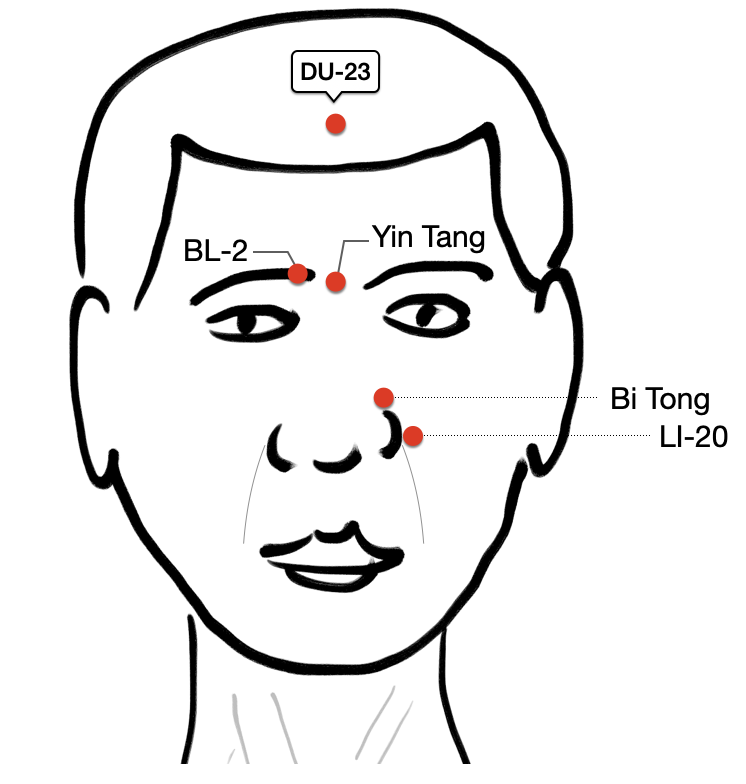
LI-20 → Bi Tong - LI-20 (Yingxiang) is on the face right next to the nose. It opens the nasal passages to treat congestion, sneezing and discharge. It can also be threaded upwards to the extra point Bi Tong (M-HN-14).
BL-2 (Zanzhu) - Located at the medial end of the eyebrow, this point of course benefits the eyes, but it also opens the nose. A Manual of Acupuncture says, "Its effect on redness and itching of the eyes, combined with its ability to treat rhinitis and sneezing, renders it particularly suitable in the treatment of hay fever."
Yin Tang (M-HN-3) - Many people use this as a point to calm the spirit, but it also benefits the nose to treat nasal congestion, discharge, rhinitis, and sinus pain.
DU-23 (Shangxing) - This point is located 1 cun into the hairline, and it's an important point for benefiting the eyes and nose. It's traditionally indicated for "inability to distinguish the fragrant from the foul," i.e., you can't smell because your nose is stuffed up.
A Manual of Acupuncture says:
Shangxing DU-23, located directly above the nose, is in a commanding position to regulate the widest range of nasal disorders and is an important point clinically in the treatment of nasal obstruction and discharge, pain of sinusitis, rhinitis, inability to smell, nosebleed and nasal polyps.
Distal Points
- LU-7 (Lieque) - This point opens the nose and benefits the head. Remember, the Lung channel itself doesn't go to the nose (it stops at the throat), but its yin-yang pair the Large Intestine channel does.
- LI-4 (Hegu) - This is the Gao Wu Command point of the face, so it's good for the face (including the eyes and nose).
Adding E-Stim
And if you like using E-Stim, the Clinical Handbook of Internal Medicine recommends connecting BL-2 and LI-4 with mild to moderate electrostimulus to treat acute episodes of rhinitis (for pretty much any pattern).
But points aren't the only option. There are a couple of other unusual things you might want to try...
Washing the Nostrils
Another recommendation made by the Clinical Handbook of Internal Medicine is to perform nasal washes.
This can clear out the allergens, dislodge the stubborn snot, and "tone the mucous membranes" to prevent recurrence.
This can be done daily during acute episodes and every other day or twice a week during remission.
(If you have some underlying yin deficiency, don't do this too often or it can aggravate the dryness.)
Now I've done some neti pots in my day, but only with salty water. So here's where it gets interesting: in certain situations, the Clinical Handbook also recommends using a weak decoction of E Bu Shi Cao (centipedae herba) or Xin Yi Hua (magnoliae flos) as a nasal wash for especially bad congestion.
I'll be honest, I've never done anything like this with herbs, but now I really want to try it!
E Bu Shi Cao is from the W.A.R.E. category, and it opens the orifices of the face, especially for red eyes and stuffy nose.
But be careful taking it internally!
The name literally means "Grass that Geese Don't Eat," and there's a reason they don't eat it: taking too much can easily cause abdominal spasms. Ask me how I know...
So if you're taking it internally, make sure you stay within the recommended range of 6–9 grams. If you accidentally take too much, ginger tea can help.
Creating a Barrier
Another recommendation from the Clinical Handbook of Internal Medicine is to create a barrier:
A simple barrier, created by smearing lanolin or vaseline around the inside of the nose at regular intervals, can prevent allergens contacting the nasal mucous membranes during the allergy season, or when allergen contact is intensified.
So I've tried this before, but for a different reason. It's really dry in Colorado, and in the winter my nasal passages would sometimes get so parched I'd put Vaseline in my nose before bed. I thought I was just being weird, but it turns out that this is a real thing!
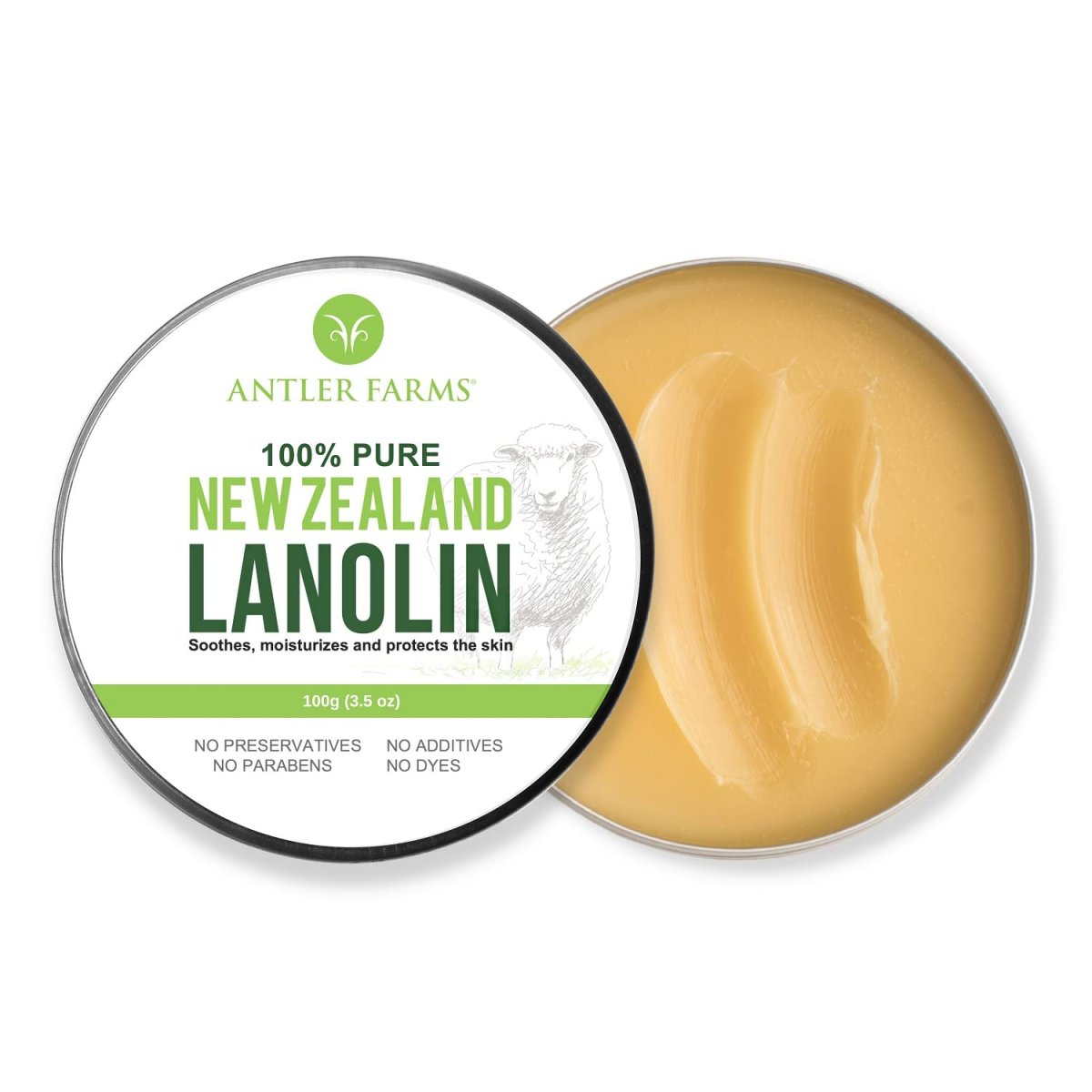
However, when I asked my AI robot friend, it came back with a small caution: there are rare instances where petroleum jelly can get into the lungs and cause problems. So it recommended sticking to lanolin or using a water-based nasal moisturizer.
But again, the Clinical Handbook adds a TCM twist: it says, "A paste made of lanolin and powdered E Bu Shi Cao can be applied to the nasal mucosa a few times daily."
So I've done a lot of things with herbs, but I've never stuck them up my nose. Again, I really want to try this.
Give It a Try
Again, the underlying root patterns are a whole other topic — but these are things you can add to any root treatment for the acute flare-ups.
So go out there and stick some Chinese herbs up your nose, and let me know how it turns out!
And if you want some ideas for herbs you can take, check out this newsletter I wrote last year about chrysanthemum tea and the patent medicine Bi Yan Pian: