Last week we talked about Four Gates for moving Liver Qi—where this point combination came from and what we can use it for.
This week we're going to talk about some alternate point pairs that you might want to use instead of Four Gates.
And both of these pairs are Jueyin points:
- LV-5 + PC-6
- LV-2 + PC-7
So let's go ahead and dive back into Liver Qi Stagnation...

The Jueyin Alternatives to Four Gates
For many practitioners, the combination Four Gates (LV-3 + LI-4) has become the go-to point pair for treating Liver Qi Stagnation.
And this is an elegant pair for several reasons:
- The points are mirror images (one on the hand and one on the foot)
- They're both Yuan-Source points
- One is yin (gate of blood) and one is yang (gate of qi)

But is this always the best combination for every patient? Or are there times when you want to get more specific with your treatment?
Here we'll talk about two alternate point combinations, both of them coming from the Jueyin channel:
- LV-5 + PC-6
- LV-2 + PC-7
Both of these come from the book Applied Channel Theory by Wang Ju-Yi (which is a really good book that you should definitely get). One is better for moving qi, and the other also clears heat.
Let's talk about each one in more detail.
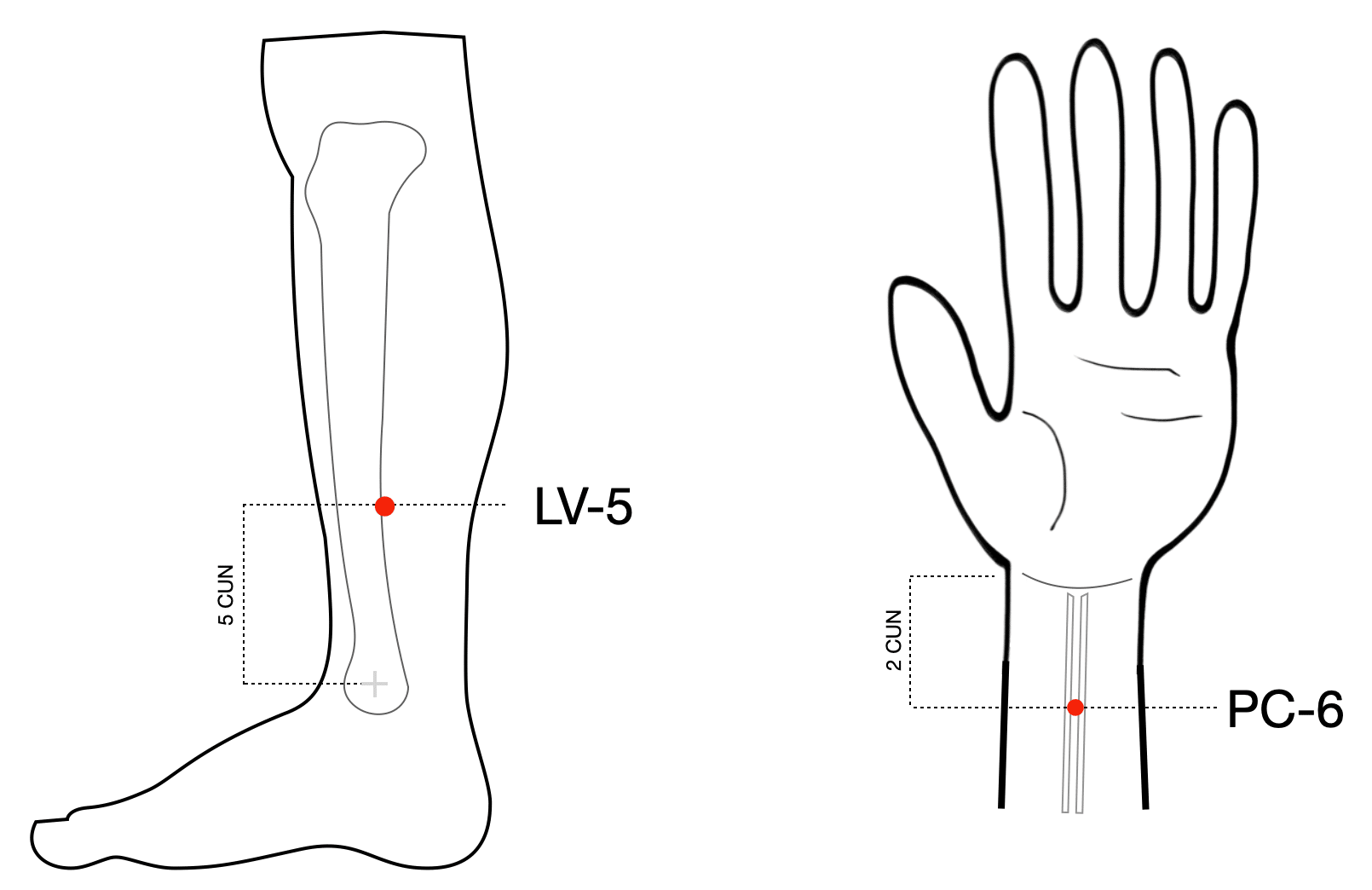

LV-5 + PC-6
This is a same-name channel pair that dredges and unblocks the Jueyin channels and collaterals.
(A "same-name channel pair" is a pair that comes from the same six-division named channel, such as Hand Taiyin and Foot Taiyin. Or in this case, Hand Jueyin and Foot Jueyin.)
Wang Ju-Yi likens this action to "shaking out a fold in a piece of cloth or stretching out a string that has become twisted or wrapped upon itself."

Clinically, this often shows up as irregular menses with qi stagnation, which includes symptoms of general lack of motivation.
These points are both Luo-Connecting points—it's the Luo-Connecting point on both the Hand and Foot Jueyin channels. This means they can stimulate circulation down to the smallest levels of the Jueyin channel, in both the jing and the luo.

Personally, I like to use this pair when I see emotional issues due to constraint.
(For example, I once had a patient who was stressed and had a lot of pent-up emotions. She seemed like she just needed to let things out and have a good cry. So I included this point pair, and she ended up crying on the table. She felt a lot better after she had that release.)
If you remember back to Points 1, one of the functions of Luo-Connecting is to treat psycho-emotional disorders. And this shows up in the individual point indications too:
- LV-5: plum-pit qi, depression, fear and fright, fright palpitations, worried oppression
- PC-6: insomnia, poor memory, fear and fright, sadness, apprehensiveness
So if you have a patient who feels twisted and wrapped up, is lacking motivation, or needs an emotional release (and you believe that this is due to Liver constraint), then LV-5 + PC-6 might be a good combination to use.
But while this pair can treat lack of movement in the Jueyin, it doesn't clear any heat. For that we could go to a different pair...
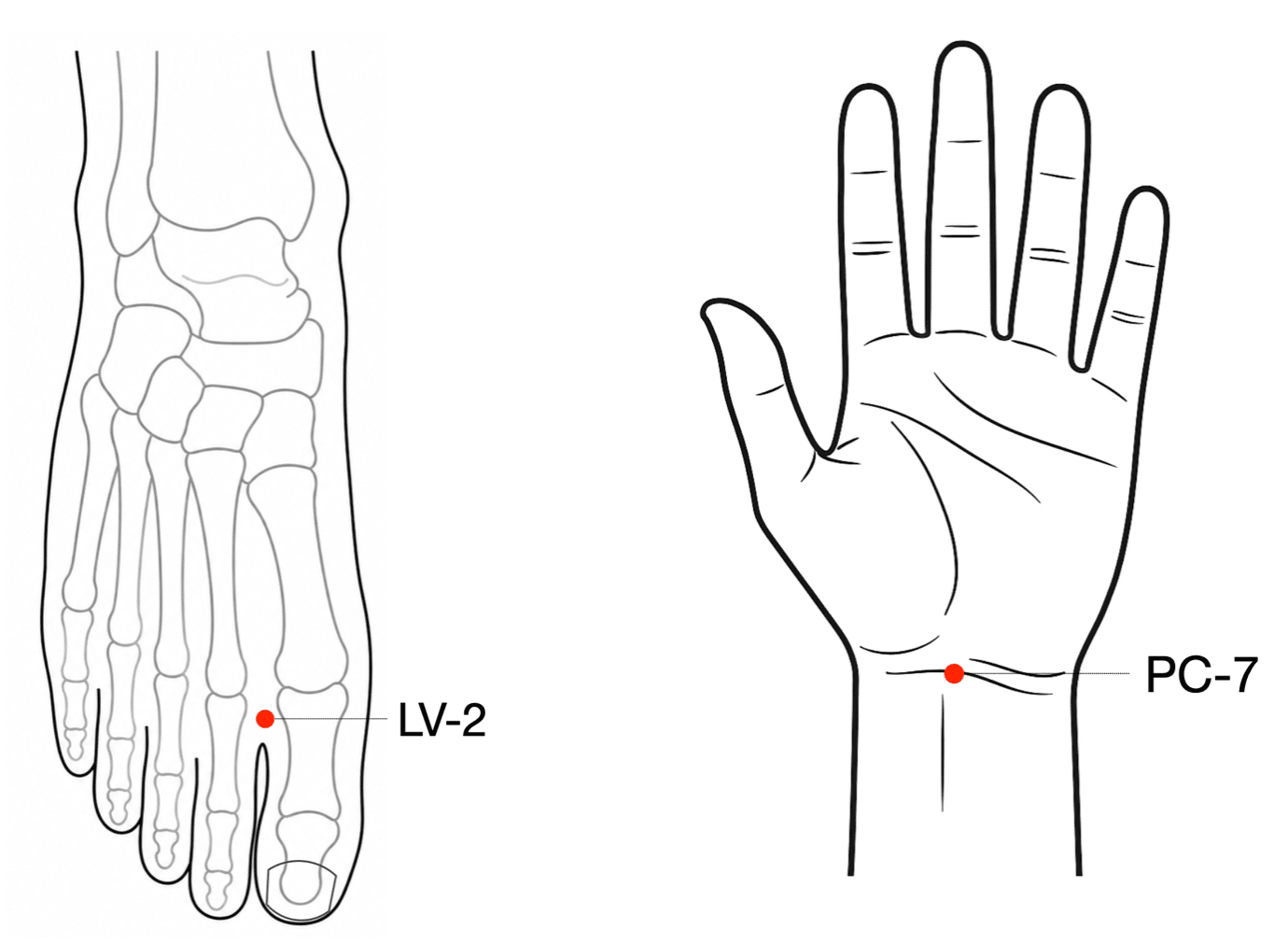
LV-2 + PC-7
This is also a same-name channel pair on the Jueyin, but besides transforming stagnant qi and blood, it also clears heat.
The reason is that these are both draining points: LV-2 is the Fire point on the Wood channel, and PC-7 is the Earth point on the Fire channel.
So according to the Five Phases, these are both child points, which means they can be used to sedate or drain the channel.
That makes this pair better at clearing heat. For example, with irregular menses, you might use this pair when you see things like irritability, restlessness, or other heat signs.
Wang Ju-Yi also points out:
In general emotional conditions in relatively young patients, due to excessive stress, often cause stagnation that leads to heat in the Jueyin. This point pair can also be appropriate in those conditions.

Which Pair Should You Use?
So that's the main difference between these two pairs: one is better for just moving, and the other is better for situations where the stagnation is causing heat.
And while Four Gates is an elegant pair, I often find myself using one of these instead.
After all, Four Gates doesn't really clear heat. So if you see stagnation with heat, you might prefer to use LV-2 and PC-7.
And for me, if I see emotional issues, I'm much more likely to use LV-5 and PC-6 over Four Gates.

So what about you? Have you ever used these point pairs in clinic, or do you prefer to stick to Four Gates?
Let me know what you think.
These pairs are on yin channels, but sometimes yang points are better for moving qi. So next time we'll talk about Shaoyang point pairs that can treat stagnation.